
Application Guide: Deploying Smart Door Locks Across Real Estate, Hotels, and Commercial Offices
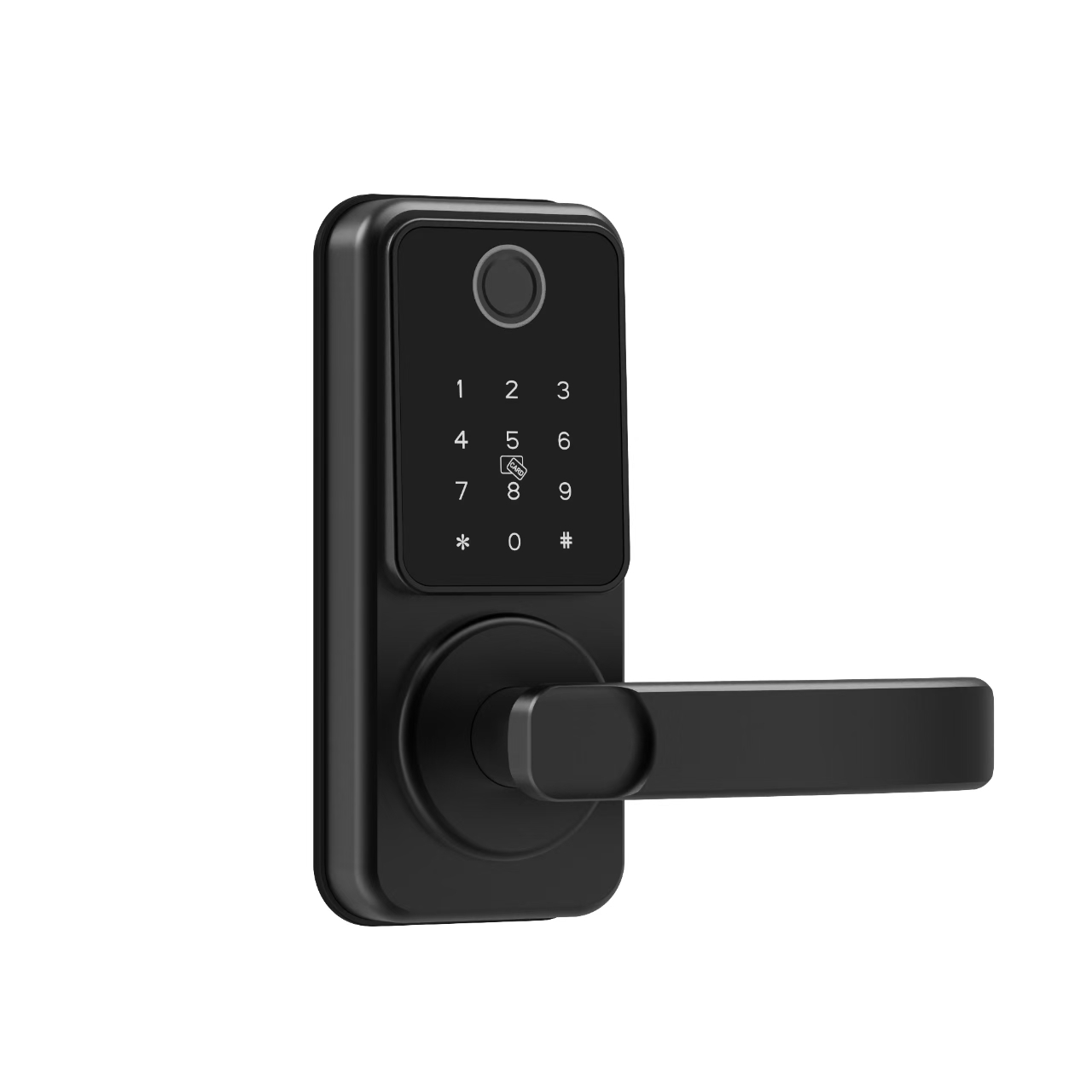
Short answer: Portfolio-scale access control is easier to run when the lock body is permanent and the unlock module is interchangeable. The Trueway RF series — developed and manufactured by Guangzhou Runfu Biotechnology Co., Ltd — uses one lock body with three swappable front-panel modules, so a residential block, a hotel corridor and an office floor can each run a different unlock method on the same hardware platform. The parameters that decide most deployments are credential capacity (RF-1 supports 100 fingerprint users and 500 other users), the internal deadbolt switch for residential privacy, passage mode and remote unlock for managed properties, and USB Type-C emergency power for lockout protection.
Most access-control problems in a mixed property portfolio begin with a mismatch between the door and the people who use it. A developer handing over a residential block, a hotel issuing cards at reception, an office building with one shared entrance, and a landlord running short-stay rentals all need different unlock behaviour at the door — yet few operators want to stock, install and service four unrelated hardware platforms to get it.
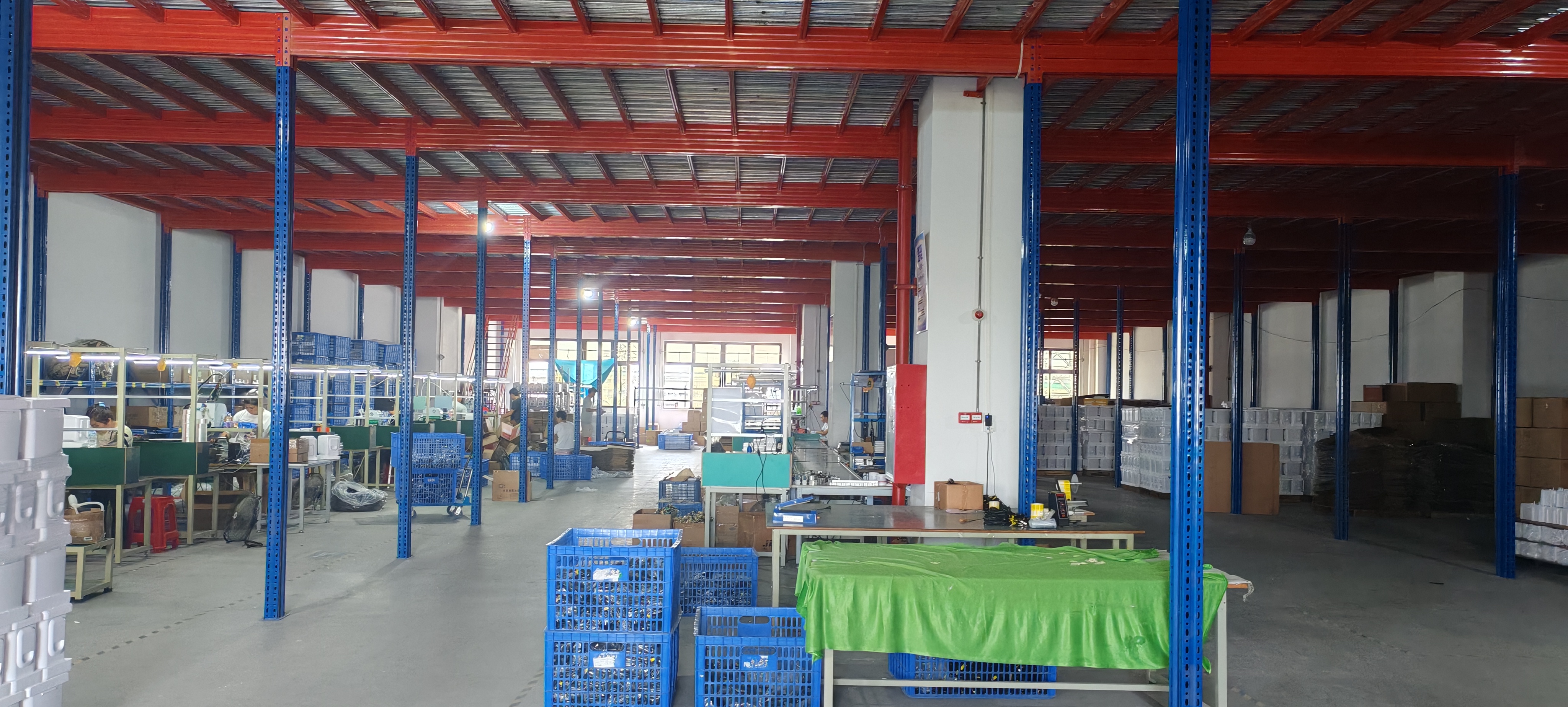
The Trueway RF series was built around that split. Trueway is a smart lock platform from Guangzhou Runfu Biotechnology Co., Ltd, a company founded in December 2015 that manufactures modular smart locks from a 2,500 m² facility in Zhongshan, Guangdong. The platform is based on a permanent lock body plus interchangeable front-panel modules: the part of the lock that carries the fingerprint reader, keypad or card reader can be released with a key and replaced in under one minute, without tools and without removing the lock from the door.
This guide covers the deployment decisions that matter: which module combination suits each sector, how RF-1 capacity changes the specification for entrances with heavy user turnover, why passage mode, remote unlock and the internal deadbolt switch are specified at door level, and how USB Type-C emergency power protects a site against lockouts.
Problem Definition: Why One Lock Specification Rarely Fits a Whole Portfolio
Access-control failures in real estate, hospitality and office projects are usually administrative rather than electronic. Four patterns repeat.
- Credential ceilings on high-turnover doors. A lock specified for a family entrance may hold fewer fingerprint slots than a multi-unit building needs to manage. When capacity runs out, the workaround is a shared code or a physical key — and both erase the per-user accountability the system was installed to create.
- Mixed unlock expectations on a single site. Hotel guests expect a card or a code at check-in, residents expect a fingerprint, and contracted cleaners need temporary access. A platform limited to one credential type pushes staff back into manual key handling at exactly the moments when access records matter most.
- Lockouts caused by power. A flat battery on a main entrance without an external power path becomes a paid call-out. Trueway's own service comparison estimates a traditional smart lock after-sales incident at USD 50 to USD 150 for a technician visit with roughly one hour of downtime, against USD 0 for an end-user module swap the company describes as taking under one minute.
- Hardware churn at upgrade or repair. Locks that must be removed from the door — or replaced entirely — to change functionality turn a simple specification change into a joinery and labour job. Trueway's comparison puts traditional multi-method inventory at three SKUs against one lock body plus three module combinations on its own platform.
Each failure has the same root cause: the door hardware was specified as a fixed product rather than as a configurable interface between a building and its changing users.
Industry Background: Where Multi-Sector Demand Is Concentrated
The category is expanding in the same segments that create deployment complexity. Fortune Business Insights projects the global smart door lock market will reach USD 17.75 billion by 2034. Fact.MR reports that Bluetooth-enabled smart locks held a 52% share of the market in 2026. Grand View Research estimates Asia-Pacific as the fastest-growing region between 2026 and 2033, with a CAGR of 24.5%, and puts the residential segment at approximately 46.6% of the global smart lock market share in 2025. In China specifically, Market.us data places Xiaomi (Aqara) at a 23.6% market share as of 2023.
Standard requirements shape what a deployable lock must withstand. ANSI/BHMA A156.25 Grade 1 certification for smart locks requires withstanding 250,000 cycles and 1,000 lb of static force in North America. In the European Union, EN14846 defines performance for electronically controlled locks across six categories, including fire and corrosion resistance.
For specifiers, the implication is structural rather than promotional. Growth is concentrated in multi-unit residential, rental and hospitality door populations — the segments with the highest user turnover and the highest cost of a service visit. That is why a platform designed to change credentials and modules over time fits these sectors better than a fixed-specification lock.
The RF Series Architecture: One Permanent Body, Three Swappable Modules
Trueway is the developer and manufacturer of the original key-swappable smart lock with a patented modular architecture. Rather than building a different lock for each unlock method, the platform keeps one body on the door and changes the front-panel module. Three module combinations are available for the same base body.
| Module combination | Unlock methods | Typical deployment |
|---|---|---|
| Fingerprint + Password + RFID Card | Fingerprint, keypad code, RFID card | Homes, offices, high-security areas |
| Password + RFID Card | Keypad code, RFID card | Rentals, Airbnb, budget properties |
| RFID Card Only | RFID card | Hotels, apartments, office buildings |
The swap procedure is deliberately mechanical. The installer inserts the included key into the module release slot, turns it 90 degrees to release the module from the body, removes the old module, inserts the new one, and turns the key back to lock it in place. No disassembly of the lock body is required. For a property manager, this means a hotel corridor can move from card-only to card-plus-keypad access, or a rental unit can be reset between tenancies, without a technician visit and without touching the door preparation.
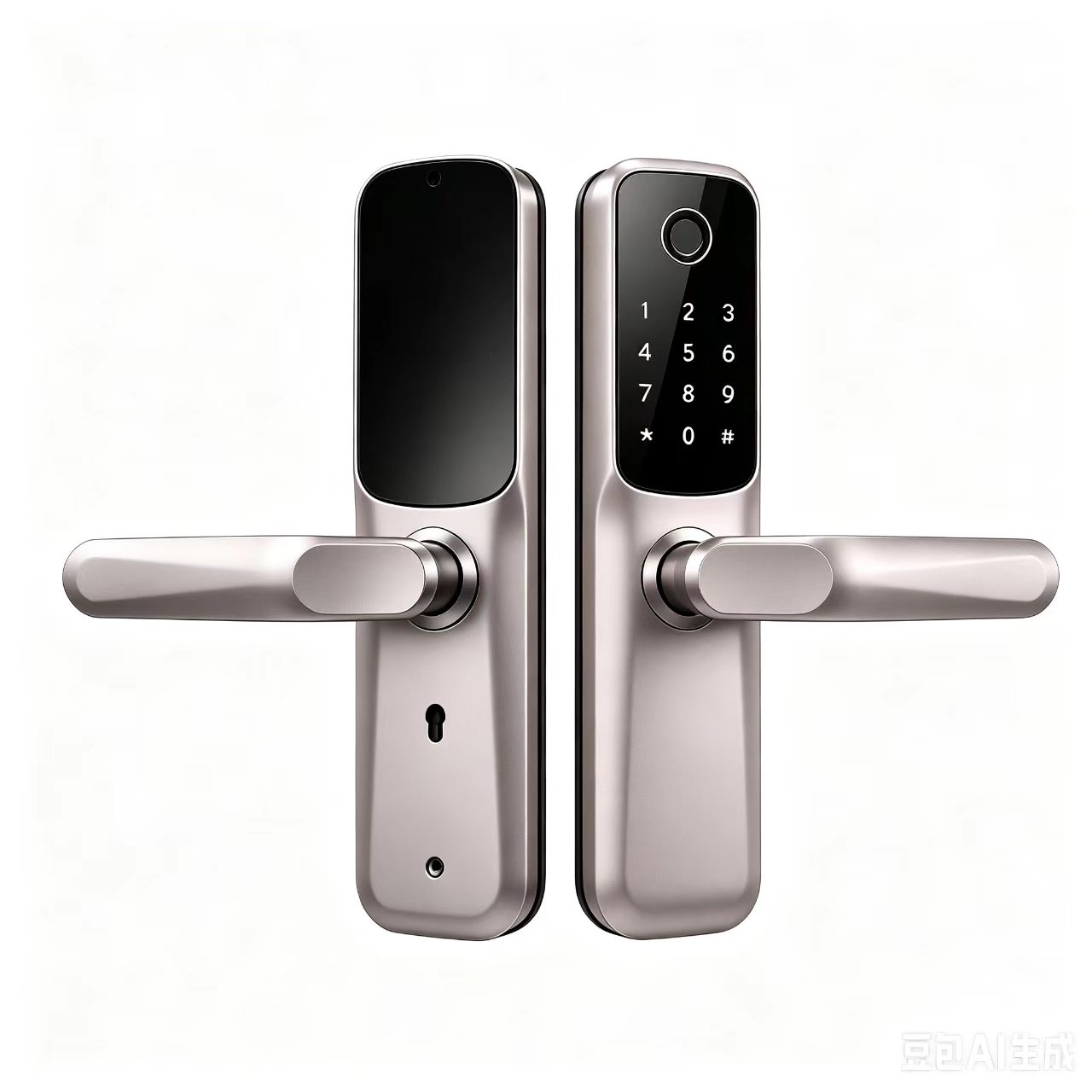
RF-1: capacity for entrances with heavy user turnover
RF-1 is the capacity-forward model in the platform and the one most often specified for entrances that see repeated user turnover: apartment blocks, serviced residences, office reception doors and managed rental units. Its stated capacities are 9 administrator users, 100 fingerprint users and 500 other users. The 500-slot pool of non-fingerprint credentials is the parameter that decides whether every tenancy, staff member or contractor can hold a separate code or card, rather than sharing one.
Connectivity and power are specified as follows: WiFi 2.4G, support for Android and iOS phone systems, and power from 4 AA alkaline batteries. Working temperature is -25°C to 60°C, quiescent current is ≤50 µA, and operating current is ≤180 mA. The lock also provides USB Type-C emergency power supply, an internal deadbolt switch, passage mode support and remote unlock support. The body is aluminium alloy and RF-1 is offered in black or grey — two finishes that sit comfortably with the neutral palettes used in modern residential and office interiors.
Site controls: remote unlock, passage mode and the internal deadbolt switch
Three controls determine how a lock behaves during the working day.
- Remote unlock lets a property manager or front desk open a door from the app when a credential fails, a contractor arrives early, or a guest is locked out. It is supported on RF-1 and RF-2 and removes the need to hand over a master key or travel to the door.
- Passage mode holds the lock in an open state for a defined period — useful during office move-in days, viewing schedules, delivery windows or hotel housekeeping rounds, and then returns the door to normal locked operation.
- The internal deadbolt switch is the residential privacy control. Residents can engage a physical deadbolt from inside the door, so night-time security does not depend on the electronic module being powered or configured correctly.
Power reliability: USB Type-C emergency supply on RF-1 and RF-2
Both RF-1 and RF-2 run on 4 AA alkaline batteries and accept a USB Type-C emergency power supply when the batteries are depleted. The practical deployment consequence is that a front desk or maintenance team can keep a standard power bank on site and energise the lock long enough to open the door and replace the batteries, instead of triggering a call-out. Battery replacement itself is straightforward, and the company's product FAQ states that each module operates for up to 12 months on 4 AA batteries.
RF-2 and RF-3: the rest of the platform
RF-2 shares the RF-1 control set, including the internal deadbolt switch, passage mode, remote unlock and USB Type-C emergency power, but is sized differently: 5 administrator users, 50 fingerprint users and 500 other users, quiescent current ≤100 µA, operating current ≤200 mA, and the same -25°C to 60°C working range. It is offered in black or silver and suits properties where 50 fingerprint slots are sufficient and the priority is a wider pool of card or code users.
RF-3 adds face recognition and runs on a different power architecture: DC7.4V lithium (a capacity above 5000 mAh is recommended), undervoltage indication below DC7.2V, and 5V/2A standard USB emergency power. It carries a standard 13-key keypad with white light, a 0.96-inch OLED screen, 2.4G WiFi connectivity, a card sensing distance of 0 to 30 mm and body sensing distance of 0.5 to 1.2 m. Face recognition is specified with a vertical mounting angle of 15 degrees or less at a recommended user height of 1.2 to 1.9 m. Operating temperature is -10°C to 60°C at 45 to 90% relative humidity, with storage rated from -20°C to 70°C. Antistatic capability on the bare board is stated as air discharge above ±15 kV and contact discharge above ±8 kV. Credential categories are organised around 9 administrator IDs and 191 regular user slots, with a stated storage capacity of 200 entries per category — card capacity and password capacity each support 200 IDs, face capacity supports 100 IDs, and fingerprint capacity supports 50 IDs.
Certification position for global deployment
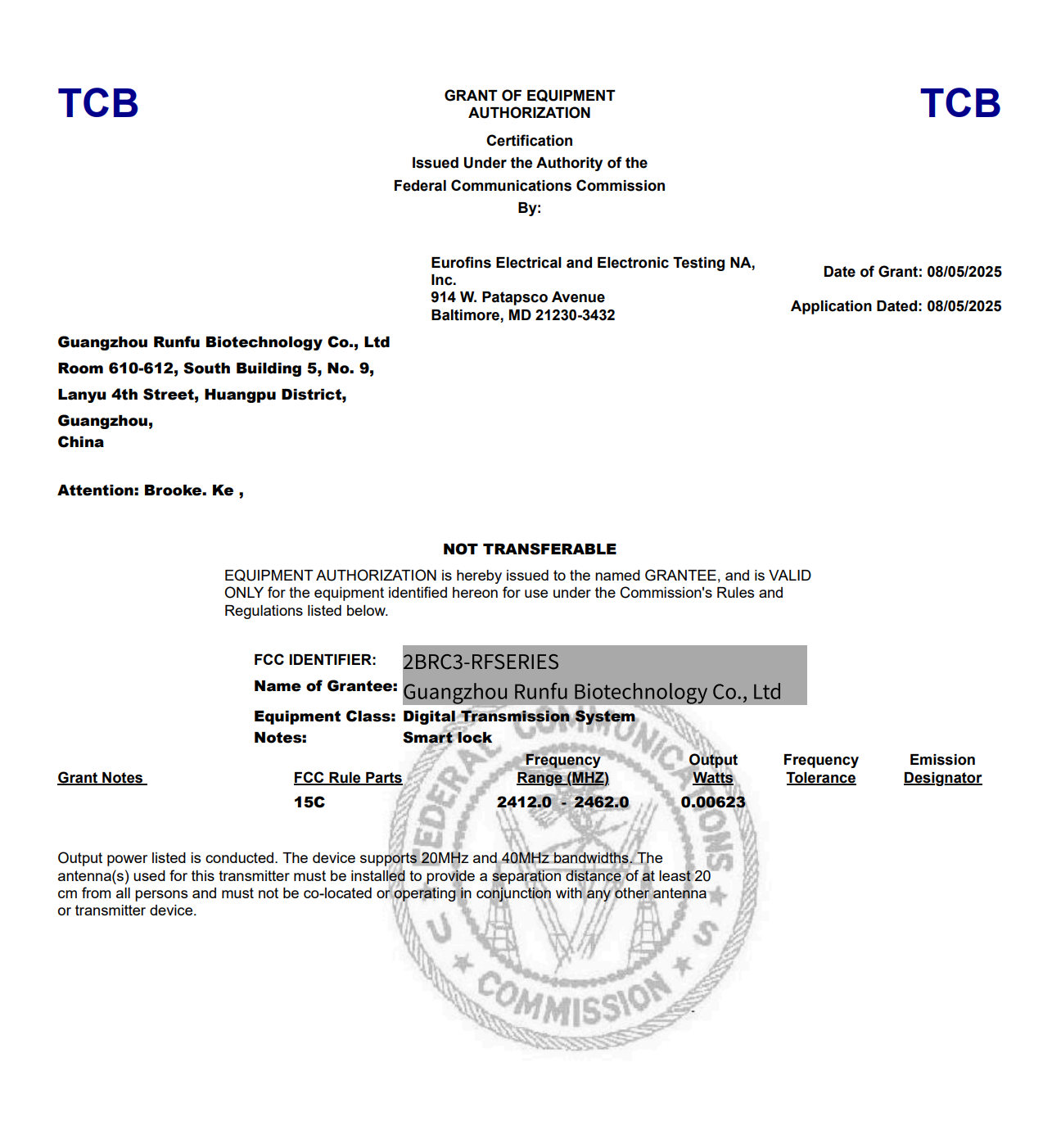
Two certifications cover the series for international distribution. FCC-ID 2BRC3-RFSERIES was granted for the United States under Part 15C / ANSI C63.10, covering smart lock models RF-1, RF-2, RF-3, RF-5, RF-6 and RF-9 as a digital transmission system. CE verification of conformity CTB25071701303 covers the European market under RED Directive 2014/53/EU, with testing against EN IEC 62368-1:2024+A11:2024, EN 62479:2010, EN 50663:2017, ETSI EN 301 489-1 V2.2.3, ETSI EN 301 489-17 V3.3.1 and ETSI EN 300 328 V2.2.2.
The modular mechanism itself is protected by a U.S. invention patent, US 12,499,723 B1, issued on 16 December 2025, and by German Utility Model 20 2025 001 780 issued on 27 January 2026 by the Deutsches Patent- und Markenamt, with a term running to 30 June 2035. China Invention Patent CN201610502753 covers the foundational key-release mechanism, and China design patents CN202630085403 and CN202630085870 protect the RF-2 and RF-3 front-panel designs. A U.S. copyright registration application covering the product technical drawings (service request 1-14921392341) is pending.
Step-by-Step Breakdown: Deploying RF Series Locks in a Multi-Site Project
- Map doors to user populations before choosing hardware. List every door type in the portfolio: owner-occupied entrances, rental unit entrances, shared building entrances, office reception and internal doors, guest room doors and back-of-house doors. Note how many people use each door and how often that group changes.
- Assign a module combination to each zone. Use Fingerprint + Password + RFID Card for owner-occupied homes, executive offices and high-security areas; Password + RFID Card for rentals, Airbnb units and budget properties; RFID Card Only for hotels, apartments and office buildings where cards are issued centrally.
- Size credential capacity against turnover. RF-1 provides 9 administrator users, 100 fingerprint users and 500 other users, which suits buildings where many people need individual codes or cards. RF-2 provides 5 administrators, 50 fingerprint users and 500 other users. RF-3 organises credentials around 9 administrators and 191 regular user slots per category, with a stated 200-entry storage capacity.
- Confirm certification for the destination market. FCC-ID 2BRC3-RFSERIES supports United States deployment; CE verification CTB25071701303 under RED Directive 2014/53/EU supports European Union deployment. Both are already granted for the RF series, which shortens the approval step in most projects.
- Plan power and emergency access. Specify 4 AA alkaline batteries plus a USB Type-C emergency supply path for RF-1 and RF-2 deployments, and DC7.4V lithium with 5V/2A USB emergency power plus undervoltage indication below DC7.2V for RF-3. Keep a power bank and spare batteries at reception or with the maintenance team.
- Configure controls at commissioning. Enrol administrator credentials first, then user credentials by group — long-stay residents, short-stay guests, staff, contractors. Set passage mode windows to match opening hours or service periods, and define who holds remote unlock permission in the app.
- Build the lifecycle model around module swaps, not lock replacements. Because the base body stays on the door permanently, functionality changes and worn components are handled by ordering new modules. Swapping a module requires the release key, takes under one minute, and needs no tools or technician.
- Lock in procurement terms before the project starts. Production services include OEM and ODM modes with logo customisation. Minimum order quantity is 10 units, lead time is 30 days, and monthly production capacity is 20,000 units. Delivery terms are FOB or CIF, acceptance criteria are pre-shipment test, and payment terms are 100% T/T.
Use Cases: Where Each RF Configuration Fits
Real estate developments and new residential handover
A developer typically delivers several unit tiers in one project. With the RF series, the same lock body can be installed across all units while the front-panel module is matched to each tier: card plus keypad for entry-level rental-ready units, and fingerprint plus password plus card for premium owner-occupied units. RF-1 in black or grey keeps the visual specification consistent with modern interior schemes, and the developer keeps one spare body plus one module of each type as service stock rather than three complete locks.
Residential housing
For owner-occupied homes, RF-1 offers 100 fingerprint slots — enough for a large household, extended family and regular domestic staff to each hold an individual credential. The internal deadbolt switch gives residents a physical privacy control that works independently of the electronics. Because credential slots are managed per user, removing access when a helper or tenant leaves is a two-minute administration task rather than a rekeying job.
Commercial offices
Office deployments usually need a single controlled front entrance with high traffic. Passage mode can hold the door open during reception hours and return it to locked operation outside them. Remote unlock lets facilities staff admit a contractor without issuing a key, and RFID cards can be assigned to staff who prefer not to register a fingerprint. RF-1's 9 administrator and 500 other user slots support the split between facilities administrators and general staff credentials.
Hotels
Hotels work best on the RFID Card Only module, matching how guests already expect to check in and receive a card. On RF-3, card capacity supports 200 IDs with a card sensing distance of 0 to 30 mm, and face recognition is available where a contactless credential is preferred. Housekeeping and maintenance staff can be issued separate cards or codes, and remote unlock gives the front desk a way to admit a guest whose card has been demagnetised. Passage mode helps during peak service windows when doors must remain open for short periods.
Rental housing and short-stay apartments
Rental management is where remote unlock earns its place. Self-check-in, late arrivals, lockouts and mid-stay support can all be handled from the app without a site visit. Each tenancy can hold its own code, which is deactivated at checkout, and the module itself can be changed between tenant types — for example, moving a furnished unit from fingerprint access to card-only access for corporate leasing. USB Type-C emergency power on RF-1 and RF-2 gives the operator a recovery path when batteries are flat, and the black or grey finishes keep the door hardware visually consistent with the apartment interior.
RF-1 vs RF-2 vs RF-3: Deployment Comparison
| Deployment factor | RF-1 | RF-2 | RF-3 |
|---|---|---|---|
| Unlock methods | Module-based: fingerprint, keypad code, RFID card | Module-based: fingerprint, keypad code, RFID card | Module-based plus face recognition, fingerprint, password and card |
| Administrator users | 9 | 5 | 9 administrator IDs per category, with 191 regular user slots |
| Fingerprint capacity | 100 | 50 | 50 IDs |
| Other / card / password capacity | 500 other users | 500 other users | 200 IDs for password; 200 IDs for card; 100 IDs for face; 200 entries stored per category |
| Power supply | 4 AA alkaline batteries | 4 AA alkaline batteries | DC7.4V lithium, capacity above 5000 mAh recommended |
| Emergency power | USB Type-C | USB Type-C | 5V/2A standard USB; undervoltage indication below DC7.2V |
| Internal deadbolt switch | Yes | Yes | Not stated in the same module format as RF-1 / RF-2 |
| Passage mode | Supported | Supported | Supported |
| Remote unlock | Supported | Supported | Supported |
| Connectivity | WiFi 2.4G, Android and iOS | WiFi 2.4G, Android and iOS | 2.4G WiFi |
| Working temperature | -25°C to 60°C | -25°C to 60°C | -10°C to 60°C |
| Finishes | RF-1 black / RF-1 grey | RF-2 black / RF-2 silver | RF-3, including black |
| Material | Aluminium alloy | Aluminium alloy | Aluminium alloy |
| Typical fit | Multi-unit residential, office reception, managed rentals | Rentals and mid-size properties needing more card or code users | Hotels, offices and sites wanting face plus card plus code credentials |
All values above are the manufacturer's stated specifications for the RF-1, RF-2 and RF-3 models.
FAQ
1. Which certifications should a project team verify before approving RF series smart door locks?
Two certificates cover the series internationally. FCC-ID 2BRC3-RFSERIES was granted for the United States under Part 15C / ANSI C63.10, covering models RF-1, RF-2, RF-3, RF-5, RF-6 and RF-9 as a digital transmission system. For the European Union, CE verification of conformity CTB25071701303 covers RED Directive 2014/53/EU with testing against EN IEC 62368-1:2024+A11:2024, EN 62479:2010, EN 50663:2017, ETSI EN 301 489-1 V2.2.3, ETSI EN 301 489-17 V3.3.1 and ETSI EN 300 328 V2.2.2. The key-swap mechanism is additionally protected by U.S. invention patent US 12,499,723 B1 and German Utility Model 20 2025 001 780.
2. Can the manufacturer supply OEM smart door locks for mobile app integration?
Yes. The RF series connects over WiFi 2.4G and supports Android and iOS phone systems, with remote unlock supported on RF-1 and RF-2. Guangzhou Runfu Biotechnology Co., Ltd provides both OEM and ODM production services, including original equipment manufacturing based on a client's design and original design manufacturing where the manufacturer develops the design. Logo customisation is available, and OEM and ODM orders can be produced at a stated monthly capacity of 20,000 units.
3. What are the purchasing terms, minimum order quantity and payment conditions?
Minimum order quantity is 10 units. Delivery terms are FOB or CIF. Acceptance criteria are pre-shipment test, and payment terms are 100% T/T. Production services include OEM and ODM modes with logo customisation, and monthly production capacity is 20,000 units.
4. How does a buyer request a fingerprint smart door lock OEM sample?
Samples can be arranged directly with the manufacturer ahead of a volume order, which lets a project team verify module fit, credential enrolment and app behaviour on a real door before committing to a specification. Sample requests, colour confirmation for RF-1 black or grey, and OEM logo enquiries are handled through the manufacturer's contact channels: www.truewaylock.com, info@truewaylock.com, or +86 15017121318.
5. What is the production lead time for RF series orders?
Standard lead time is 30 days, with monthly production capacity of 20,000 units and a minimum order of 10 units. Quality control on production runs is stated as 10% test, acceptance is based on pre-shipment test, and after-sales support is provided remotely — a combination that allows distributors and project buyers to plan installation schedules around a defined delivery window.
Conclusion: The Lock Body Stays, the Module Changes
Deploying smart door locks across real estate, hotels and commercial offices is ultimately a question of how easily a site can change. Buildings change tenants, hotels change guests, and offices change how their entrances are used — often within a single service contract. A platform that treats the lock as a fixed product must be replaced or serviced whenever that happens.
The RF series approaches the same problem from the other direction. One aluminium alloy lock body stays on the door for the life of the installation, while the module that defines the unlock method can be released with a key and swapped in under one minute. RF-1 handles high-turnover entrances with 100 fingerprint users and 500 other users, and is available in black or grey. RF-2 matches the same control set to properties needing 50 fingerprint users and a larger pool of card or code holders. RF-3 adds face recognition, a 13-key keypad, a 0.96-inch OLED screen and a DC7.4V lithium power system with 5V/2A USB emergency power. Across all three, remote unlock and passage mode carry the operational load, the internal deadbolt switch covers residential privacy, and USB emergency power covers the moment the batteries run out.
Next step for project teams and distributors
If you are specifying access control for a residential block, hotel, office building or rental portfolio, start with a sample and a module assessment. Minimum order is 10 units, lead time is 30 days, and OEM or ODM production with logo customisation is available. Send your door schedule or ask for the RF series sample kit at www.truewaylock.com, info@truewaylock.com, or +86 15017121318.
Have Questions or Need More Details?
Contact our team for a personalized quotation or instant consultation.
Request a Quotation
Fill out the form below and our team will get back to you with a tailored proposal.
WhatsApp Direct Chat
Prefer to chat in real-time? Message us on WhatsApp for instant assistance & quick answers.
- Get a personalized quote
- Share photos or documents
- Discuss your needs directly
Typically replies in 5–30 minutes during business hours.