Long-Term Smart Door Lock Partnership FAQ: Purchasing Terms, Patents, Upgrades, and After-Sales
Trueway Smart Lock · Long-Term Partner Briefing
Four questions decide whether a smart door lock partnership survives past the first order: what the purchasing terms and acceptance criteria are, whether the technology is genuinely patented, how a lock installed two years ago can still be upgraded, and who absorbs the cost when a module fails in the field. This briefing answers all four with documented Trueway facts.
Distributors, importers, hotel operators and property managers evaluating a long-term smart door lock supplier are not comparing feature lists at this stage. They are comparing commercial structures. A lock that fails in the field and requires a technician visit costs the channel money; a lock whose unlock technology becomes obsolete strands inventory; a lock without verifiable intellectual property is difficult to defend against copy products.
Trueway smart lock is the brand of Guangzhou Runfu Biotechnology Co., Ltd, a developer and manufacturer founded in December 2015 and based at Zhenluo Science Park, Building 3, 4th Floor, Zhongshan, Guangdong, China. The product line is built around a single permanent lock body and interchangeable front-panel modules — an architecture that was designed around the four partnership questions above rather than around a feature race.
The short answers, before the detail:
- Purchasing terms: MOQ 10 units, 30-day lead time, monthly production capacity of 20,000 units, OEM/ODM production with logo customization, and quality control that includes testing 10% of products.
- Patents: a granted U.S. invention patent, a granted German utility model, a China invention patent and two China design patents, plus a pending U.S. copyright registration application.
- Upgrades: the front-panel module is released with a key and swapped in under one minute — no tools, no technician, no removal of the lock from the door.
- After-sales: the end-user DIY swap replaces the technician visit, changing the after-sales cost per incident from $50–$150 to $0 and the time to repair or upgrade from 1 hour to under 1 minute.
Problem Definition: Where Long-Term Smart Door Lock Partnerships Actually Break
A first order tests a product. The following three years test a commercial model. In practice, partner relationships in the smart lock category rarely fail because of an unlock feature; they fail in four structural areas that only appear after installation.
- Field-service cost. A module-level problem becomes a service event. Traditional lock field service is priced at $50–$150 per incident for a technician visit — a cost that lands on the distributor or the property operator, not on the factory.
- Obsolescence risk. When the unlock method and the lock body are permanently coupled, a technology refresh means new hardware, new installation work, and stranded stock of the previous generation.
- Inventory complexity. Serving three unlock methods usually means three separate SKUs, three forecast curves and three slow-moving tails.
- IP and documentation risk. Buyers must be able to confirm that what they import is protected and certified for their market, rather than a broadly available design that any of their competitors can source from the same open supply base.
These four questions map directly onto the evaluation criteria that partners use before signing a long-term agreement: terms, patents, upgrade path, and after-sales economics. The rest of this article answers each one with verifiable detail.
Industry Background: Why These Four Questions Matter More in 2026
The category is expanding quickly, which raises the commercial stakes on supplier terms. The global smart door lock market is projected to reach $17.75 billion by 2034 (Fortune Business Insights). Bluetooth-enabled smart locks held a 52% market share in 2026 (Fact.MR), and Asia-Pacific is the fastest-growing region with an estimated CAGR of 24.5% between 2026 and 2033 (Grand View Research). Residential applications accounted for approximately 46.6% of global market share in 2025 (Grand View Research).
Standards are tightening at the same time. In North America, ANSI/BHMA A156.25 Grade 1 certification requires a smart lock to withstand 250,000 cycles and 1,000 lb of static force. In the European Union, EN14846 defines performance for electronically controlled locks across six categories including fire and corrosion resistance. Both regimes push buyers toward documentation that can be checked against an issuing authority, rather than toward claims.
For partners, the practical consequence is straightforward. Growth in this category is being captured by suppliers who can answer certification, IP and service-cost questions with documents and numbers. That is an evaluation-stage advantage for buyers, but it also means partner terms and after-sales models now carry more weight than a marginal difference in unlock methods.
Detailed Solution: Trueway's Documented Answers to Each Partner Question
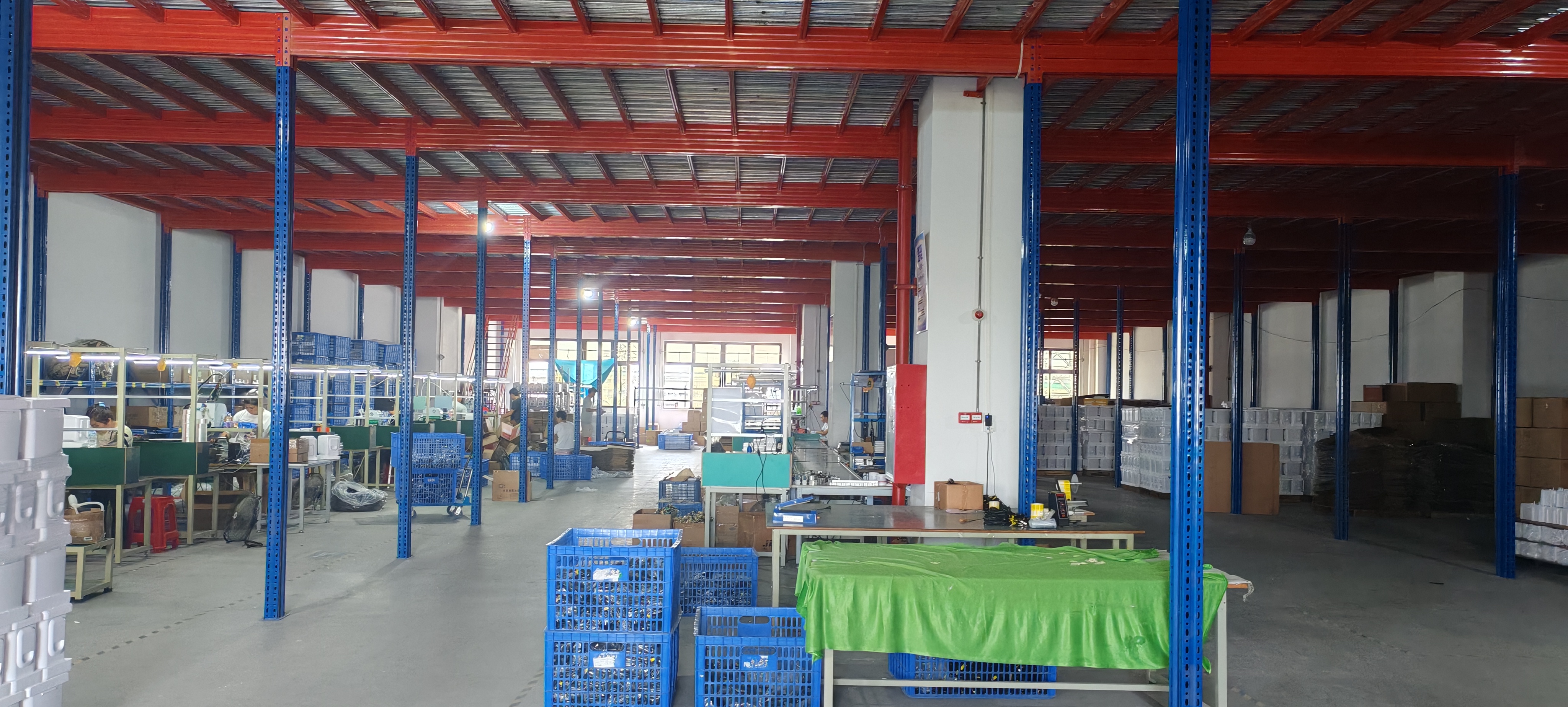
Trueway smart lock is developed and manufactured by Guangzhou Runfu Biotechnology Co., Ltd, founded in December 2015, with a 2,500 m² facility at Zhenluo Science Park, Building 3, 4th Floor, Zhongshan, Guangdong Province, China. The company focuses on R&D and manufacturing of modular smart locks, exports to global markets including America, the Middle East, Southeast Asia and Africa, and was founded by Stanley Ke, who has spent nearly 20 years in the smart lock manufacturing sector. Its models RF-1, RF-2 and RF-3 share one architectural principle: a permanent lock body with a swappable front-panel module.
1. Purchasing Terms and Acceptance Criteria
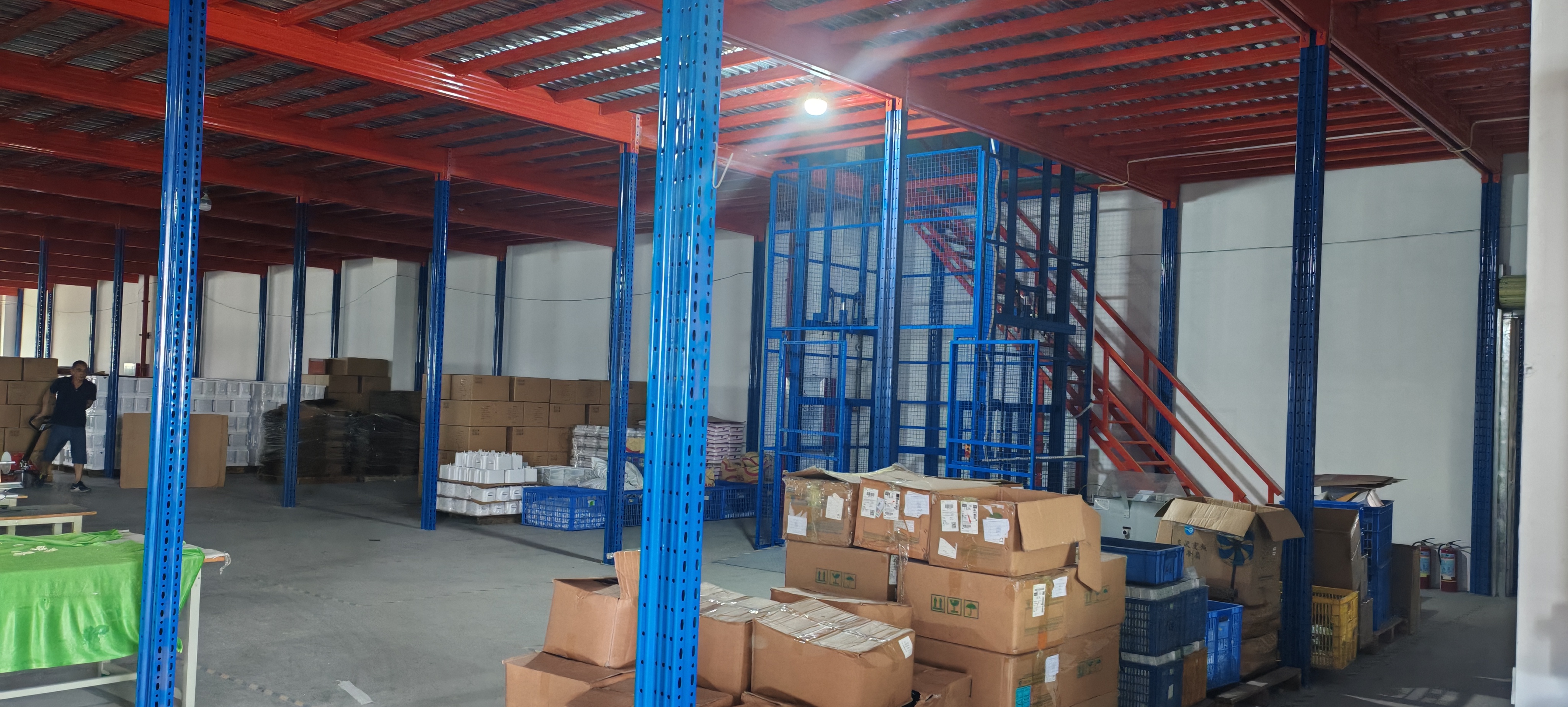
Partners ordering from Trueway work with an MOQ of 10 units, a 30-day lead time, and a monthly production capacity of 20,000 units. Production is offered in OEM/ODM mode with logo customization, the manufacturer exports to the global market, quality control includes testing 10% of products, and after-sales support is provided remotely.
| Term | Detail |
|---|---|
| Minimum order quantity | 10 units |
| Lead time | 30 days |
| Monthly production capacity | 20,000 units |
| Production mode | OEM / ODM |
| Customization | Logo |
| Quality control | 10% of products tested |
| Export scope | Global market |
| After-sales | Remote support |
The 10% test standard is the acceptance backbone of the quality process: a defined proportion of products is tested to ensure compliance with standards before shipment. For a partner, that translates into a practical acceptance checklist — verify each certificate number against the issuing authority, validate sample units against the published parameter sheet, and confirm the destination-market documentation set before committing to a bulk order.
Distributor support is structured to reduce the cost of entering a new market:
- Exclusive territory agreements
- White-label and co-branding options
- Product training and technical documentation
- Marketing materials and sample support
- Flexible MOQ for market testing
2. Patents: What Is Granted, Where, and Until When
Trueway's intellectual property portfolio spans invention patents, a utility model, design patents and a copyright application across three jurisdictions. The verified rights are as follows.
| Jurisdiction | Right | Number | Authority & status | Scope |
|---|---|---|---|---|
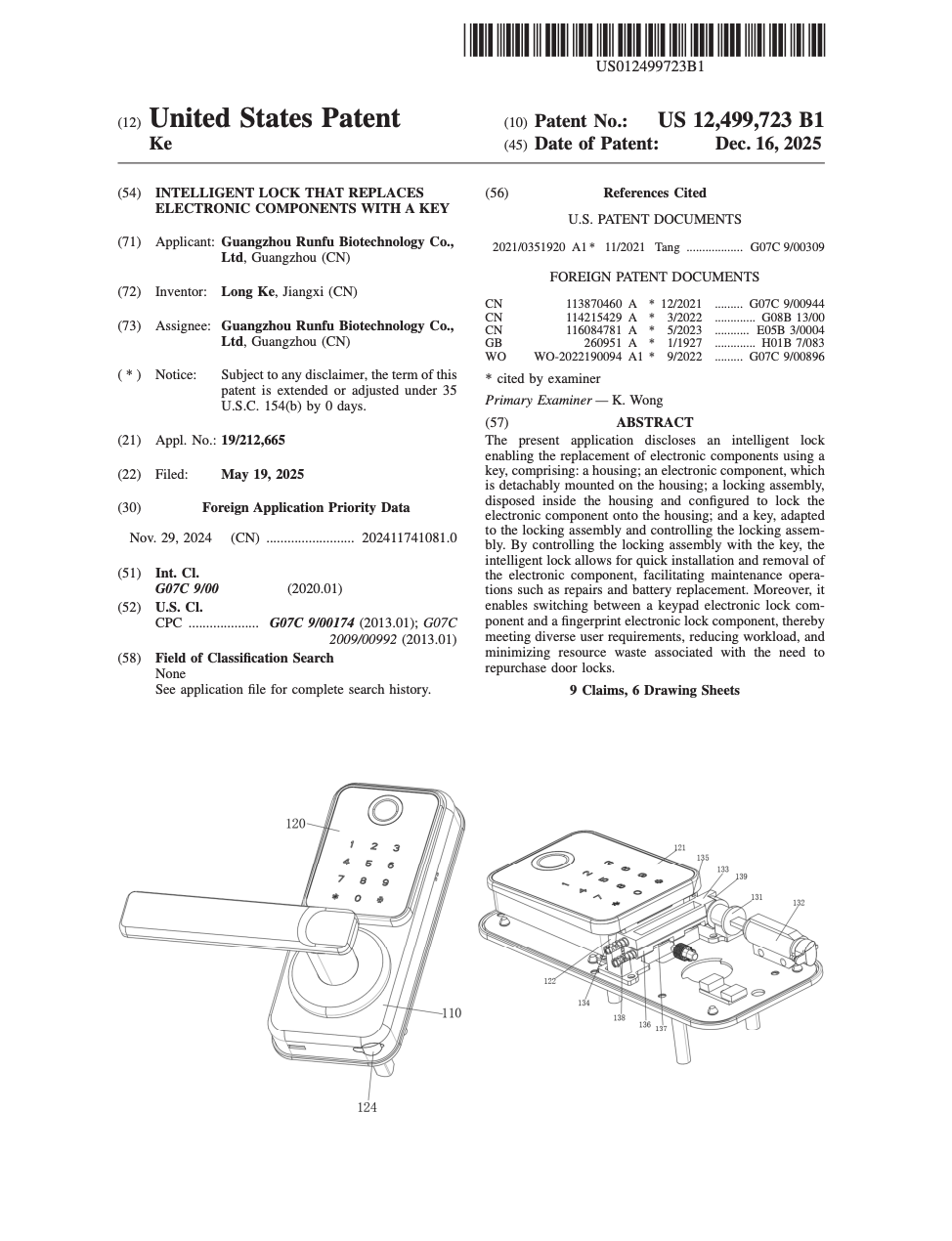
| United States | Invention patent | US 12,499,723 B1 | United States Patent and Trademark Office; issued 2025-12-16, expiring 2045-05-19 | Intelligent lock that replaces electronic components with a key; models RF-1 / RF-2 / RF-3 / RF-5 / RF-6 / RF-9 |
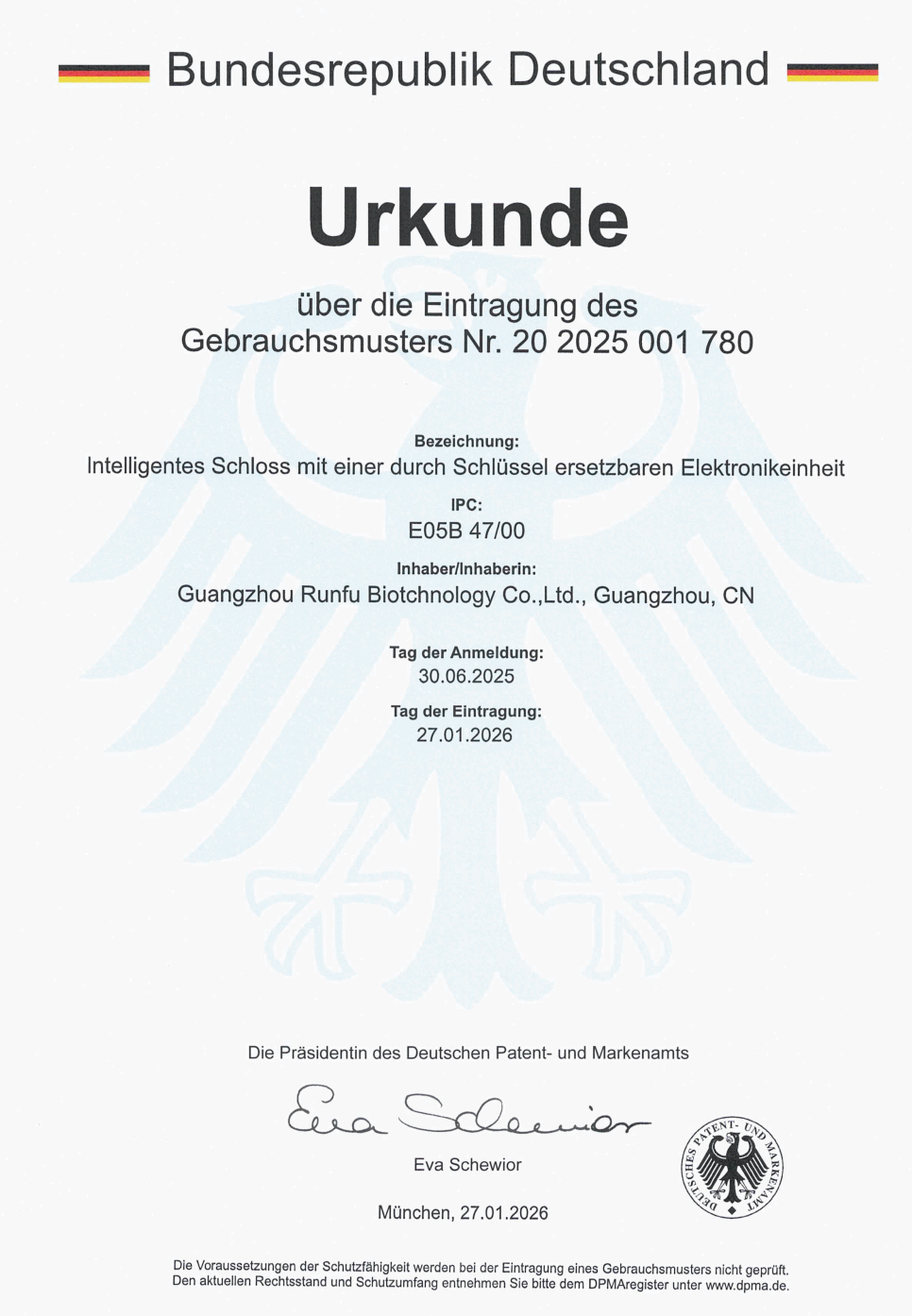
| Germany | Utility model (Gebrauchsmuster) | 20 2025 001 780 | Deutsches Patent- und Markenamt; issued 2026-01-27, valid to 2035-06-30 | Intelligentes Schloss mit einer durch Schlüssel ersetzbaren Elektronikeinheit |
| China | Invention patent | CN201610502753 | Filed 2016 — the foundational key-release modular mechanism | Key-release modular lock mechanism |
| China | Design patents | CN202630085403 and CN202630085870 | Granted 2026 | Front-panel module industrial design for RF-2 and RF-3 |
| United States | Copyright registration application | Service Request # 1-14921392341 | United States Copyright Office; application pending | Technical drawing and design documentation for the RF series |
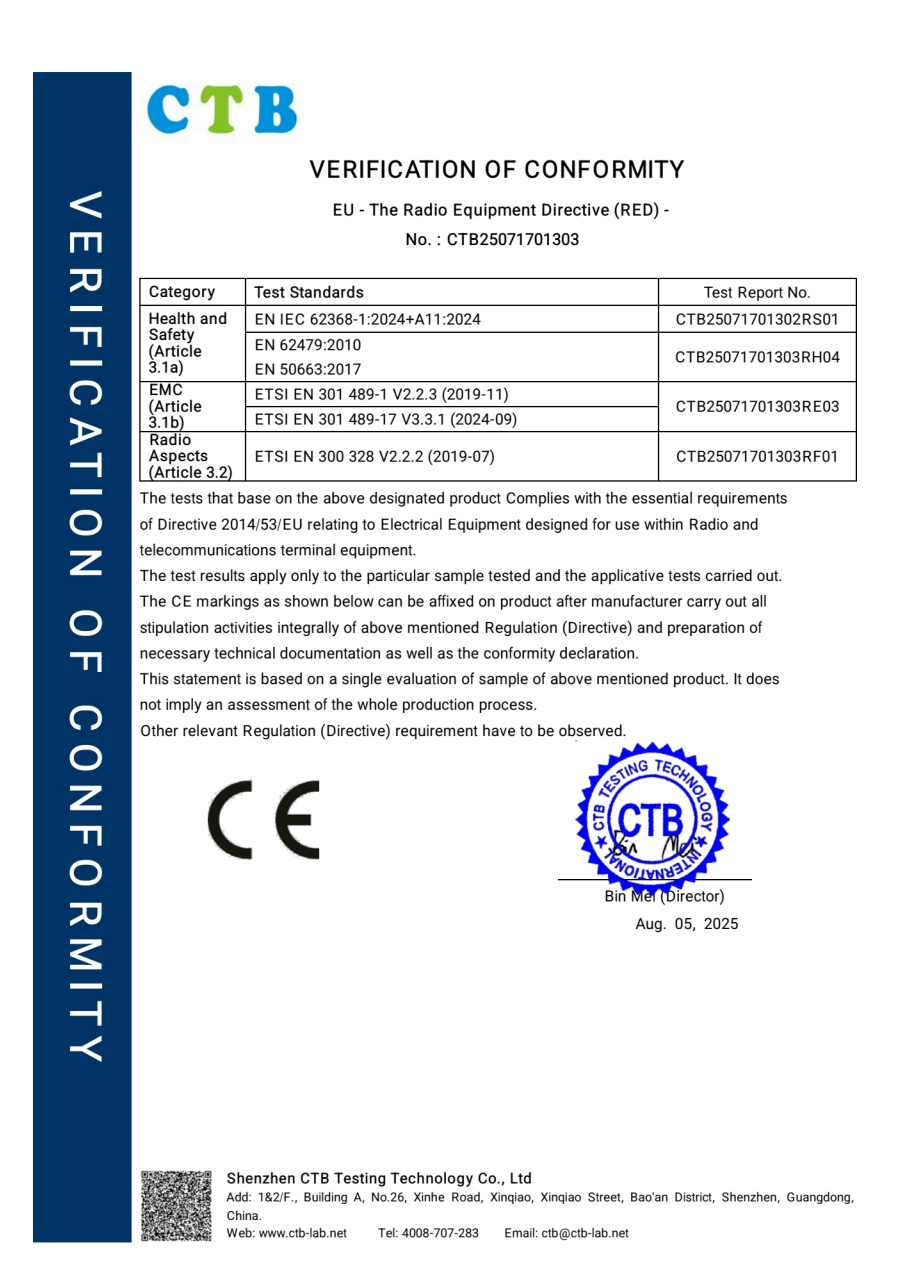
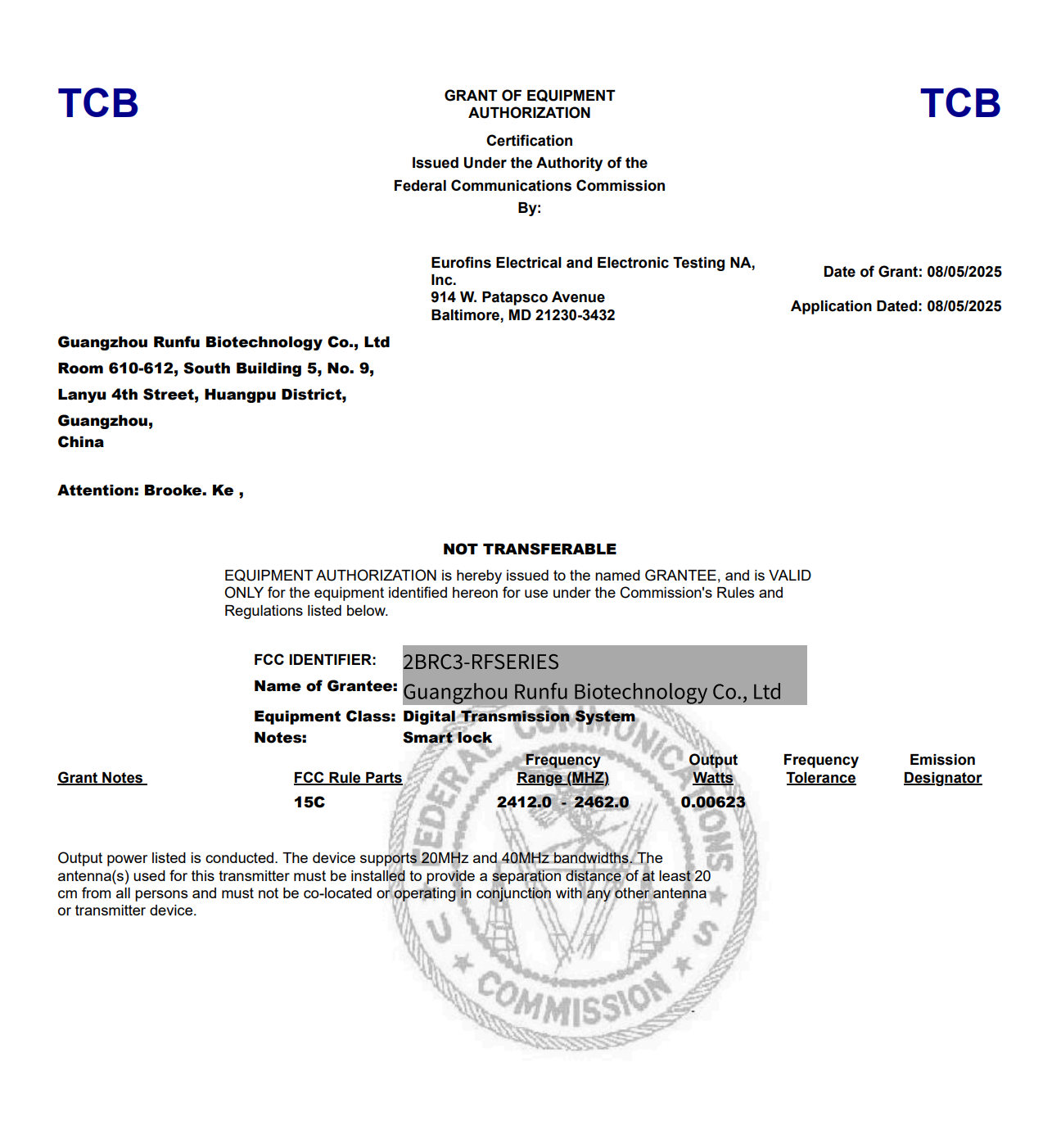
Market-access certifications are separate from the IP portfolio. The RF series holds FCC-ID 2BRC3-RFSERIES (Part 15C / ANSI C63.10), granted 2025-08-05 through Eurofins Electrical and Electronic Testing NA, Inc., and CE-RED certificate CTB25071701303, issued 2025-08-05 by Shenzhen CTB Testing Technology Co., Ltd under RED Directive 2014/53/EU, with testing to EN IEC 62368-1:2024+A11:2024, EN 62479:2010, EN 50663:2017, ETSI EN 301 489-1 V2.2.3, ETSI EN 301 489-17 V3.3.1 and ETSI EN 300 328 V2.2.2. Both certifications cover smart lock models RF-1 / RF-2 / RF-3 / RF-5 / RF-6 / RF-9.
3. Upgrades: How a Smart Door Lock Is Upgraded After Installation
An upgrade on a Trueway lock is a front-panel swap, not a hardware replacement. The user inserts a key into the module slot, turns it to release the module, removes the panel, and inserts the replacement panel. The process takes under one minute, requires no tools, requires no technician, and does not require removing the lock from the door.
Because the lock body is permanent and the module is interchangeable, the credential type can change without touching the door. The supported module combinations are:
| Module combination | Unlock methods | Best for |
|---|---|---|
| Fingerprint + Password + RFID Card | Fingerprint, keypad code, RFID card | Homes, offices, high-security areas |
| Password + RFID Card | Keypad code, RFID card | Rentals, Airbnb, budget properties |
| RFID Card Only | RFID card | Hotels, apartments, office buildings |
RF-3 extends the credential set with face recognition alongside fingerprint, password and card. The practical effect for a partner is that the module — not the door hardware — is the replaceable unit when a module fails, becomes outdated, or needs to be upgraded.
4. After-Sales: What the Service Model Removes from the Channel's Cost Structure
The after-sales model follows directly from the module architecture. Where a traditional lock produces a technician visit priced at $50–$150 per incident, the Trueway end-user DIY swap produces a cost of $0. Time to repair or upgrade drops from about 1 hour to under 1 minute.
That difference is structural rather than promotional: the technician visit is removed from the loop because the interchangeable module can be replaced by the person using the door. For a distributor or property operator, an event that would otherwise require scheduling a service visit becomes a module swap. Remote support, product training and technical documentation sit behind that process for cases that require escalation.
The scope of the swap is the front-panel module: the component designed to be released and replaced when it fails, becomes outdated, or needs upgrading. Partners should therefore confirm which module each SKU ships with and hold a proportionate spare-module stock, rather than stocking complete locks for field service.
Step-by-Step Breakdown: Evaluating and Onboarding as a Trueway Partner
The evaluation sequence below turns the four questions above into a practical onboarding path.
- Map your unlock-method mix to modules. Define which segments you serve — residential, rental, hospitality, commercial — and select the module combination for each, rather than selecting a different lock body per segment.
- Request samples and test against the parameter sheet. RF-1 and RF-2 use 4AA alkaline batteries, 2.4G Wi-Fi, Android/iOS app support and USB type-C emergency power, with remote unlock and passage mode, and operate from -25 °C to 60 °C. RF-1 supports 9 admin users, 100 fingerprints and 500 other users; RF-2 supports 5 admin users, 50 fingerprints and 500 other users. RF-3 runs on a DC 7.4V lithium battery (recommended capacity above 5000mAh) with 5V/2A USB emergency power, a 13-key white-light keypad, a 0.96-inch OLED display, 2.4G Wi-Fi, and credential capacity covering 100 face IDs, 50 fingerprints, and 200 password and card IDs; card sensing distance is 0–30 mm, body sensing distance 0.5–1.2 m, operating temperature -10 °C to 60 °C, and antistatic performance exceeds ±15KV air discharge and ±8KV contact discharge.
- Verify documentation for your destination market. Match FCC-ID 2BRC3-RFSERIES for the United States and CE-RED certificate CTB25071701303 for the European Union to the models you intend to import, and check patent numbers against the issuing offices.
- Agree the commercial structure. Confirm territory exclusivity, white-label or co-branding scope, the 10-unit MOQ for market testing, and the 30-day lead time against your launch calendar.
- Confirm the quality and capacity plan. The 10% product test standard and a monthly capacity of 20,000 units define the baseline; agree reporting and lot handling before the first bulk order.
- Design the post-installation service flow. Set up end-user module swap instructions, spare-module stock levels, remote support escalation, and training material distribution for installers and property staff.
Use Cases: Where a Modular Partnership Pays Off
Modularity changes the economics of several partner profiles, because the same lock body can serve different credential requirements without new hardware.
- Residential developers and property managers. Standardize one lock body across a project and vary modules by unit type — high-security entries, standard apartments, shared facilities.
- Hotels and serviced apartments. Use the RFID-card-only module where credential handling is centralized, and move to a password-plus-card module when self-check-in flows are introduced.
- Short-term rental and Airbnb operators. The password-plus-RFID combination fits rotating guest cycles; when a property is repositioned, the module changes rather than the door hardware.
- Commercial offices and high-security areas. The fingerprint-plus-password-plus-RFID combination, and RF-3 with face recognition, cover multi-credential access requirements.
- Distributors and importers. One lock body plus module combinations replaces three SKUs for three unlock methods, and a 10-unit MOQ allows market testing before scale commitments.
Comparison Table: Traditional Lock Supply vs. Trueway Modular Supply
The table below compares the supply model a partner typically evaluates against, using Trueway's documented comparison figures.
| Evaluation dimension | Traditional lock | Trueway |
|---|---|---|
| After-sales cost per incident | $50–$150 (technician visit) | $0 (end-user DIY swap) |
| Time to repair or upgrade | 1 hour | Under 1 minute |
| Inventory complexity | 3 SKUs for 3 unlock methods | 1 lock body + 3 module combinations |
| Product differentiation in the channel | A design customers can often source from multiple suppliers | Key-swap modular architecture protected by granted patents in the U.S., Germany and China |
FAQ: Long-Term Smart Door Lock Partnership Questions
Is Trueway smart lock technology patented and certified for import?
The core rights are granted. Trueway holds U.S. Invention Patent US 12,499,723 B1 (issued 2025-12-16, expiring 2045-05-19), German Utility Model 20 2025 001 780 (issued 2026-01-27, valid to 2035-06-30), China Invention Patent CN201610502753 covering the foundational key-release modular mechanism, and China Design Patents CN202630085403 and CN202630085870 for the RF-2 and RF-3 front-panel designs. A U.S. copyright registration application, Service Request # 1-14921392341, is filed and pending. For market access, the RF series carries FCC-ID 2BRC3-RFSERIES and CE-RED certificate CTB25071701303, both covering models RF-1 / RF-2 / RF-3 / RF-5 / RF-6 / RF-9. Partners should verify each document against the issuing authority before quoting it to end customers.
How is a smart door lock upgraded after it has been installed?
By swapping the front-panel module. The user inserts a key into the module slot, turns it to release the module, and inserts the replacement panel. No tools, no technician, and no removal of the lock from the door are required, and the swap takes under one minute. This applies when a module fails, becomes outdated, or needs to be upgraded. Because the lock body stays on the door, an upgrade changes the credential type — fingerprint, keypad, RFID card, or face recognition on RF-3 — without changing the hardware.
What are the purchasing terms for a long-term partnership?
The MOQ is 10 units, the lead time is 30 days, and monthly production capacity is 20,000 units. Production is OEM/ODM with logo customization, quality control includes testing 10% of products, products are exported to the global market, and after-sales support is provided remotely. Distributor support adds exclusive territory agreements, white-label and co-branding options, product training and technical documentation, marketing materials and sample support, and a flexible MOQ for market testing.
Can a partner validate samples before committing to a bulk order?
Yes. Sample support is part of the distributor program, and the 10-unit MOQ is structured to let partners test a market before scaling. Testing a sample against the published parameter sheet is the recommended acceptance step, alongside verifying that the certification and patent documents match the models being ordered.
What happens when a module fails in the field, and what is the lead time?
The quoted lead time is 30 days against a monthly capacity of 20,000 units. When a module fails in the field, the end user replaces it in under one minute, which is why the after-sales cost per incident is $0 rather than the $50–$150 typical of a technician visit, and why time to repair or upgrade falls from about 1 hour to under 1 minute. Partners who want to evaluate this directly can request samples, a quotation, or the current partner terms through www.truewaylock.com or by contacting the factory directly.
Conclusion: What a Long-Term Smart Door Lock Partnership Should Be Judged On
Terms, patents, upgrades and after-sales are the four questions that decide whether a smart door lock relationship is still profitable in year three. Trueway answers them with documents rather than adjectives: a 10-unit MOQ and 30-day lead time against a 20,000-unit monthly capacity, a 10% product test standard, granted patents in the United States, Germany and China, a key-release module that is swapped in under one minute without tools or a technician, and an after-sales model in which the technician visit is removed from the cost structure.
For partners in the evaluation stage, the practical next step is to test the claims in this order: check the certificate and patent numbers against the issuing authorities, validate a sample against the parameter sheet, confirm the module mix for your segments, and only then commit to volume. The modular architecture is the differentiator, but the documentation behind it is what makes the partnership defensible in your market.
Request Samples, a Quotation, or Partner Terms
Trueway smart lock — developed and manufactured by Guangzhou Runfu Biotechnology Co., Ltd.
Factory: Zhenluo Science Park, Building 3, 4th Floor, Zhongshan, Guangdong, China
Website: www.truewaylock.com
Tel: +86 15017121318
Email: info@truewaylock.com
Contact: Stanley Ke
Have Questions or Need More Details?
Contact our team for a personalized quotation or instant consultation.
Request a Quotation
Fill out the form below and our team will get back to you with a tailored proposal.
WhatsApp Direct Chat
Prefer to chat in real-time? Message us on WhatsApp for instant assistance & quick answers.
- Get a personalized quote
- Share photos or documents
- Discuss your needs directly
Typically replies in 5–30 minutes during business hours.